AI in Production
Building a Brain-Computer Interface
TLDR: I spent three years building a production AI system that reads emotions from brain activity. The hardest part was never the model. It was strapping EEG caps on real humans, synchronizing multichannel biosignals with millisecond precision, and making it all work outside the lab.
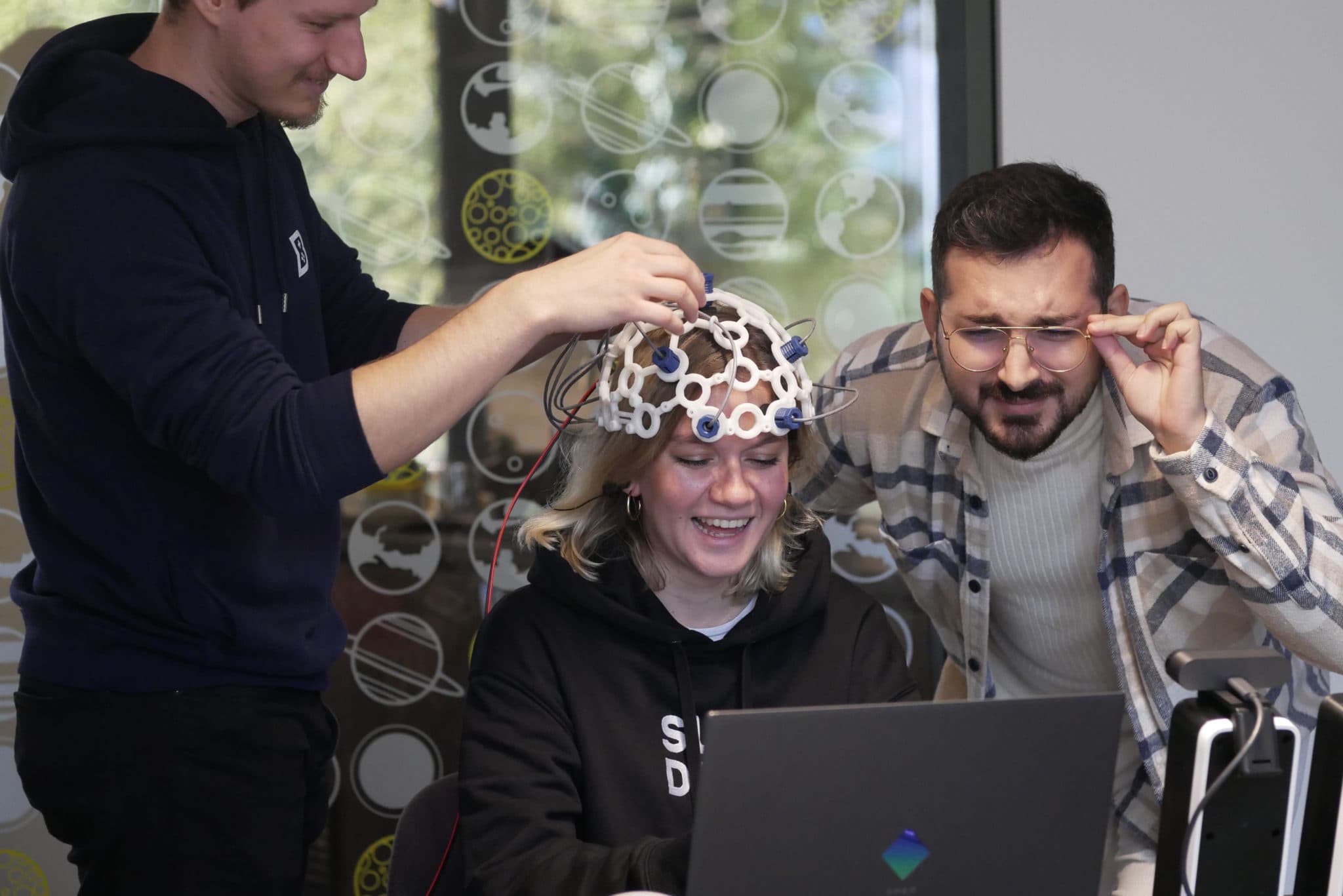
I started Brainamics right after university, off the back of winning a brain-computer interface hackathon. The premise was ambitious: could we infer emotional response from EEG data well enough to help game studios evaluate player experience?
We called it classifying flavours of noise. EEG data is high noise, low signal, and painfully sensitive to collection conditions. Getting the system to work in production meant synchronizing multichannel biosignals, behavioural logs, and video streams with millisecond precision, while controlling for batch effects and the non-generalizability that shows up the moment you leave controlled conditions. For a while, we thought our models worked. Then I discovered our evaluation was wrong. That was a hard reset: I rebuilt the pipeline with rigorous cross-validation and honest metrics, and only then did the real accuracy picture emerge.
What most people don't realize about this kind of work is how physical it is. I recruited test subjects, fitted them with EEG caps, and recorded their brain activity during live gameplay, all while handling sensitive biological data under strict protocols. I built and trained a non-technical ops team to run these sessions consistently and reliably. The gap between 'we have a model that works in a notebook' and 'we have a service we can sell to a gaming studio' was mostly an operations problem, not an AI problem.
By the end, I had led a technical team of eight from research prototype to production system. I raised $1.8M in private and public funding, won a €1M European Innovation Grant, earned a €400K investment prize, and was invited to lecture at TUM's elite neurotechnology program on real-world EEG data processing. The system worked. But I recognized that the market for non-invasive BCI wasn't there yet. I sold my shares and made the deliberate decision to build something people actually needed next.
Tools & Methods
- Python
- PyTorch
- EEG signal processing
- Transformer architectures
- ETL pipelines
- Batch-effect mitigation
- Multimodal synchronization
- Evaluation rigor
Next step